

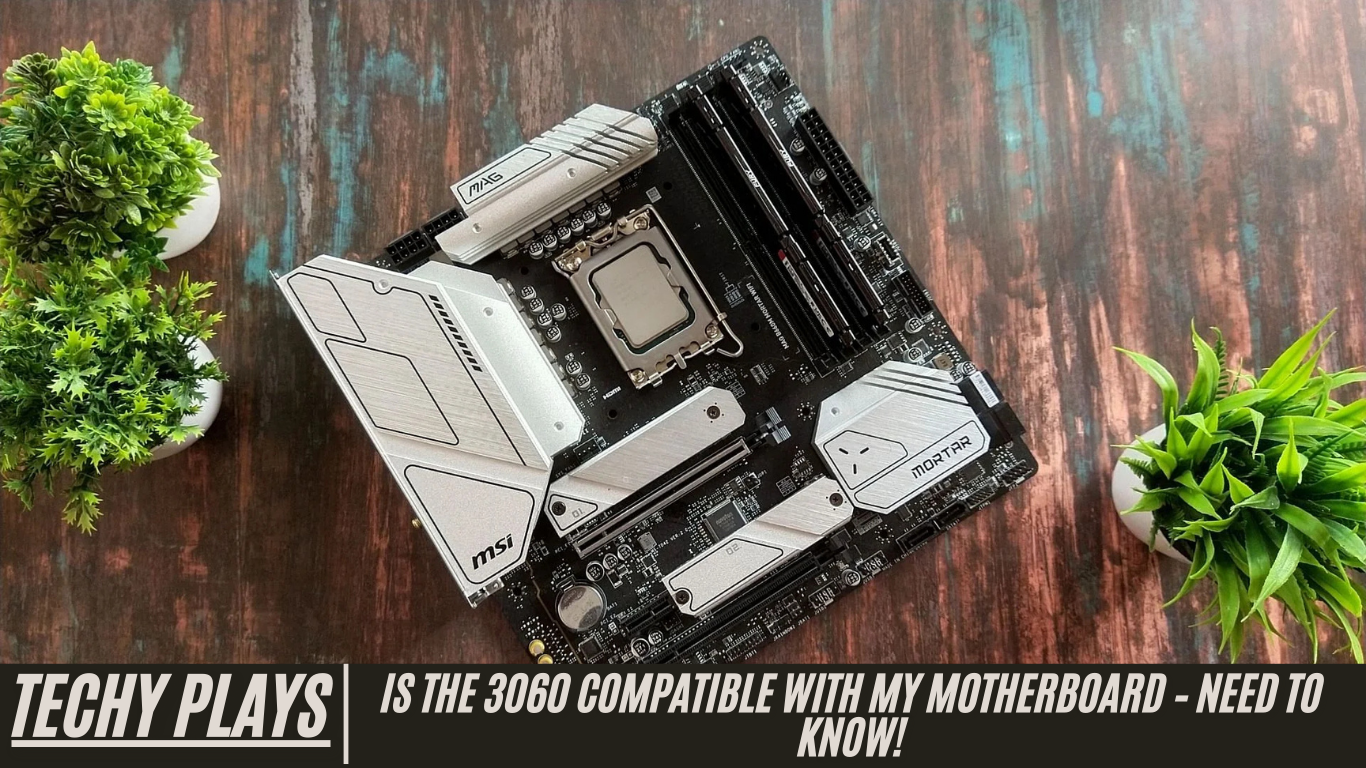
Compatibility with your existing motherboard is crucial When upgrading your PC’s graphics card
When considering an upgrade to your PC’s graphics card, understanding compatibility with your existing motherboard is essential. Choosing a high-performance GPU like the NVIDIA RTX 3060 requires ensuring that your motherboard can support it fully, both in terms of physical slot and power requirements. Ignoring this crucial step could lead to installation issues or suboptimal performance.
Yes, the RTX 3060 is compatible with any motherboard, featuring a PCIe x16 slot
The RTX 3060 is designed with broad compatibility in mind, featuring a PCIe x16 interface that works with most modern motherboards. Whether you’re running an Intel or AMD platform, as long as your motherboard has a standard PCIe x16 slot, the RTX 3060 can be installed without issues. This makes it a versatile choice for gamers and content creators looking to upgrade their graphics capabilities without needing a complete system overhaul.
In addition to the physical slot, it’s also important to consider other factors such as power supply requirements and available space within your case. The RTX 3060 requires sufficient wattage and proper cooling to ensure smooth and stable gaming performance. Ensuring your motherboard, PSU, and case can accommodate the card will help you achieve optimal results in demanding applications and modern games.
In this article, we’ll delve into the intricacies of graphics card and motherboard compatibility to help you determine whether the RTX 3060 is compatible with your setup
This guide aims to provide a comprehensive understanding of how to assess motherboard compatibility when upgrading to the RTX 3060. By examining key specifications such as PCIe slot type, power requirements, and physical dimensions, you can confidently determine whether your current setup is ready for this powerful graphics card. With careful planning and the right components, the RTX 3060 can unlock high-quality gaming experiences, faster rendering times, and smoother performance for a wide range of tasks.
Read more: Can I Use 2400mhz RAM in 3200mhz Motherboard – Exploring!
Understanding GPU Compatibility
Understanding GPU compatibility goes beyond simply checking if a graphics card fits into your motherboard. It involves evaluating several critical factors, including PCIe slot compatibility, the power supply unit (PSU) capacity, and BIOS support. Ensuring compatibility helps prevent installation issues and guarantees that the graphics card operates at its full potential. Before purchasing a new GPU, it’s essential to consult your motherboard’s manual, check official documentation, and, if necessary, visit the manufacturer’s website for compatibility guidelines. Proper research ensures a smooth upgrade and avoids costly mistakes.
Overview of GeForce RTX 3060
The NVIDIA GeForce RTX 3060 is a high-performance mid-range graphics card built on the advanced Ampere architecture. It features 12GB of GDDR6 memory, offering substantial bandwidth for gaming, creative work, and demanding applications. The RTX 3060 is optimized for excellent 1080p and 1440p gaming performance and comes equipped with real-time ray tracing capabilities, delivering immersive graphics quality. Its combination of performance and efficiency makes it an ideal choice for mainstream gamers and content creators looking to upgrade their systems without overspending on high-end GPUs.
Motherboard Compatibility Requirements
To ensure smooth installation and optimal performance, the motherboard must meet certain compatibility requirements for the RTX 3060. Key requirements include:
- A compatible PCIe slot, typically PCIe 3.0 x16 or higher, which provides sufficient bandwidth for modern GPUs.
- Adequate power supply capacity to support the graphics card’s power demands and prevent system instability.
- BIOS support to recognize and fully utilize the GPU’s capabilities, ensuring that your system boots correctly and maintains stable performance.
Meeting these requirements guarantees that the RTX 3060 can perform at its maximum potential without bottlenecks or hardware conflicts.
Checking Motherboard Compatibility
To check if your motherboard is compatible with the RTX 3060, follow these steps:
- Examine the available PCIe slots to ensure at least one PCIe x16 slot is present.
- Verify that your PSU provides sufficient wattage and necessary power connectors for the GPU.
- Confirm that your motherboard BIOS supports the RTX 3060 for proper initialization and system recognition.
For accurate information, always consult your motherboard documentation or visit the manufacturer’s website. Staying informed about specific motherboard requirements ensures seamless GPU installation and reliable system performance.
Common Compatibility Issues
Even with modern hardware, certain compatibility issues can arise when installing a new graphics card. Common problems include:
- PCIe slot incompatibility, where older or smaller slots cannot fully support modern GPUs.
- Insufficient power supply capacity, which can lead to system crashes or GPU underperformance.
- Lack of BIOS support, preventing the system from recognizing the graphics card properly.
Being aware of these potential issues allows users to troubleshoot effectively and make informed decisions when upgrading their GPU.
Compatibility with Different Motherboard Types
The compatibility of the RTX 3060 with different motherboard types depends on several factors, including the PCIe slot version, PSU capacity, and BIOS support. Whether you use an Intel or AMD platform, ensuring that these specifications meet the GPU’s requirements guarantees smooth installation and optimal gaming or creative performance. Checking these details before purchase helps avoid hardware conflicts and ensures a future-proof setup.
Understanding Motherboard Components and Specifications
A thorough understanding of motherboard components is crucial for selecting compatible hardware. Key elements include the CPU socket, RAM slots, PCIe slots, SATA ports, and the chipset. Knowing the specifications of these components allows users to match the RTX 3060 effectively with their system, optimizing performance and preventing bottlenecks. A well-informed approach ensures the graphics card functions at its full potential and integrates seamlessly with the existing hardware.
Key Factors to Consider for RTX 3060 Compatibility
When upgrading to the RTX 3060, several key factors must be considered:
- Verify that your motherboard has a PCIe x16 slot, preferably PCIe 3.0 or higher.
- Ensure your PSU can provide adequate power and has the required connectors for the GPU.
- Confirm that the motherboard BIOS supports the RTX 3060, enabling seamless integration and stable performance.
These considerations are essential for maximizing the performance and longevity of the graphics card while maintaining system stability.
Common Motherboard Chipsets Compatible with RTX 3060
The RTX 3060 is compatible with a wide range of motherboards, especially those with modern chipsets. Common compatible chipsets include Intel’s Z490, B460, and H470, as well as AMD’s B550 and X570. These chipsets provide PCIe 3.0 x16 slots and sufficient power delivery to support the RTX 3060, ensuring high-performance gaming and efficient utilization of the GPU’s features. Choosing a compatible chipset simplifies the upgrade process and guarantees optimal performance for a variety of applications.
How to Check if Your Motherboard Supports RTX 3060?
To determine whether your motherboard can support the NVIDIA RTX 3060, there are several essential steps to follow. First, identify the PCIe slots on your motherboard by consulting its specifications or user manual. The RTX 3060 requires a PCIe 3.0 x16 slot for optimal performance, though it can work with PCIe 4.0 slots as well. Ensuring your motherboard has this slot is the first critical step for compatibility.
Next, check your power supply unit (PSU) to confirm it can deliver sufficient wattage for the RTX 3060. Review the GPU’s power requirements, and make sure your PSU provides enough power with the appropriate connectors to maintain stable performance during gaming or heavy workloads.
Finally, verify BIOS support on your motherboard. Older BIOS versions may not recognize the RTX 3060 correctly, potentially leading to system errors or underperformance. Visit your motherboard manufacturer’s website to download and install the latest BIOS update if needed, ensuring full compatibility and reliable GPU performance.
Potential Issues with RTX 3060 Compatibility
While the RTX 3060 is widely compatible with modern motherboards, some potential issues can arise. One common problem is PCIe slot incompatibility. Certain older or budget motherboards may lack PCIe 3.0 x16 slots, which can limit the card’s performance.
Another potential issue is PSU capacity. An underpowered PSU may cause system instability, crashes, or failure to boot when the GPU is under load. Ensuring your PSU meets the RTX 3060’s power requirements is crucial.
Finally, BIOS support can be a hurdle. Some older motherboards may require a BIOS update to recognize the RTX 3060 correctly. Without this update, the GPU may not function at full capacity or may be entirely unrecognized by the system.
Does the B550 support the RTX 3060Ti?
Yes, the AMD B550 motherboard fully supports the RTX 3060 Ti, provided it has a compatible PCIe 3.0 x16 slot, sufficient power delivery, and BIOS support. This makes B550 motherboards an excellent choice for gamers looking to pair mid-range GPUs with modern AMD platforms without performance limitations.
Can My Motherboard Support RTX 3060? 3 Basic Compatibility To Support!
To determine whether your motherboard supports the RTX 3060, focus on three basic areas:
- A compatible PCIe 3.0 x16 slot to ensure proper bandwidth for the GPU.
- Adequate PSU capacity to deliver sufficient power for stable operation.
- BIOS support for recognizing and fully utilizing the graphics card.
Checking these three factors guarantees that the RTX 3060 will function smoothly and efficiently in your system.
Upgrading Your Motherboard for RTX 3060 Support
If your current motherboard does not meet the necessary compatibility requirements—such as lacking PCIe 3.0 x16 slots, having insufficient power delivery, or lacking BIOS support—you may need to upgrade your motherboard. Selecting a motherboard designed to support modern GPUs ensures seamless installation, stable performance, and longevity for your system.
Expert Advice on Choosing the Correct Motherboard for Your RTX 3060
When selecting a motherboard for the RTX 3060, prioritize models with PCIe 3.0 x16 slots, robust power delivery systems, and the latest BIOS support. This ensures not only compatibility but also optimal gaming and creative performance. Expert guidance emphasizes that pairing the right motherboard with your GPU prevents bottlenecks and maximizes the card’s capabilities.
Is 3060 compatible with my PC?
To confirm if the RTX 3060 is compatible with your PC, check three critical components:
- Ensure your motherboard has a PCIe 3.0 x16 slot.
- Verify that your PSU can meet the GPU’s power requirements.
- Confirm that your motherboard BIOS supports the RTX 3060.
Meeting these conditions ensures a stable and high-performing system after the GPU upgrade.
What CPU fits with RTX 3060?
The RTX 3060 pairs well with a range of mid-range to high-end CPUs. For example, Intel Core i5-10600K or AMD Ryzen 5 5600X provide a balanced combination, minimizing bottlenecks while delivering excellent gaming performance. Choosing a compatible CPU ensures your system fully leverages the RTX 3060’s capabilities in modern games and creative applications.
Is My motherboard compatible with my graphics card?
To determine motherboard compatibility with any graphics card, including the RTX 3060, check whether your motherboard has the correct PCIe slot, verify that your PSU can handle the GPU’s power requirements, and ensure BIOS support. These three factors are critical for a stable and high-performance setup.
Is RTX 3060 compatible with B550?
Yes, the RTX 3060 is fully compatible with B550 motherboards, provided that the motherboard offers a PCIe 3.0 x16 slot, sufficient power supply, and BIOS support for the graphics card. B550 motherboards are a solid choice for gamers building or upgrading mid-range systems.
Is The 3060 Compatible With My Motherboard Gaming?
To ensure the RTX 3060 is compatible with your gaming motherboard, verify three essential requirements: a PCIe 3.0 x16 slot, adequate PSU power, and BIOS support tailored for the GPU. Meeting these requirements ensures that the card delivers high-performance gaming experiences and integrates seamlessly into your system.
RTX 3060 Compatible Processor?
The NVIDIA RTX 3060 is compatible with a wide range of processors, making it a versatile choice for gaming and creative workloads. It pairs exceptionally well with mid-range to high-end CPUs such as the Intel Core i5-10600K or AMD Ryzen 5 5600X, providing a balanced system where neither the GPU nor CPU becomes a bottleneck. Choosing a compatible processor ensures that the RTX 3060 can deliver smooth 1080p and 1440p gaming performance, handle modern AAA titles, and support productivity tasks efficiently.
Best Motherboard For RTX 3060?
Selecting the best motherboard for the RTX 3060 depends on your specific requirements, budget, and the intended use of your system. Popular options like the ASUS ROG Strix B550-F Gaming or the MSI MPG B550 Gaming Edge WiFi are widely recommended for their excellent compatibility, reliable power delivery, and updated BIOS support. These motherboards provide PCIe 3.0 x16 slots, sufficient expansion options, and features tailored for gamers and PC enthusiasts, ensuring the RTX 3060 performs at its full potential.
Unraveling the ideal motherboards for RTX 3060 GPUs
Identifying the ideal motherboards for RTX 3060 GPUs involves careful consideration of several factors. Compatibility with PCIe slots, robust power delivery systems, and BIOS support are critical to ensuring the GPU operates without bottlenecks. Additionally, features like M.2 slots, RAM capacity, cooling solutions, and form factor compatibility should also be taken into account for building a well-rounded system. Selecting the right motherboard guarantees seamless integration and stable gaming performance.
How to choose motherboards for RTX 3060 GPUs?
When choosing a motherboard for the RTX 3060, prioritize models with PCIe 3.0 x16 slots to ensure proper bandwidth for the GPU. Adequate power delivery is essential for stability, especially under heavy gaming loads. BIOS support is another crucial factor to avoid recognition or performance issues. Additionally, consider form factor, expansion options for future upgrades, connectivity ports, and your overall budget to select the motherboard that best fits your system and gaming requirements.
MSI GeForce RTX 3060 Motherboard Compatibility?
MSI GeForce RTX 3060 graphics cards are compatible with most modern motherboards, provided they meet three essential requirements: a PCIe 3.0 x16 slot, sufficient power supply, and BIOS support. Ensuring these factors allows the RTX 3060 to function optimally, whether you are using MSI motherboards or other reputable brands.
Is RTX 3060 Compatible With B450?
Yes, the RTX 3060 is fully compatible with B450 motherboards. These motherboards support PCIe 3.0 x16 slots, provide sufficient power delivery, and allow for BIOS updates to enable full functionality. This compatibility makes B450 a popular choice for budget-conscious gamers looking to upgrade without replacing their entire system.
RTX 3060 Vs 3060 Ti
The RTX 3060 Ti is a higher-performance variant of the RTX 3060, featuring more CUDA cores, higher memory bandwidth, and slightly better overall performance. While the RTX 3060 is ideal for 1080p and 1440p gaming, the 3060 Ti excels in demanding gaming scenarios and higher resolution setups. Understanding the difference helps gamers select the GPU that best fits their performance needs and budget.
GeForce RTX 3060 compatibility review
The NVIDIA GeForce RTX 3060 is compatible with a wide variety of motherboards, as long as they have a PCIe 3.0 x16 slot, sufficient PSU capacity, and BIOS support. Additionally, pairing the RTX 3060 with mid-range to high-end CPUs ensures balanced system performance, avoiding bottlenecks while delivering smooth gameplay and productivity performance.
RTX 3060 Ti Motherboard Compatibility?
The RTX 3060 Ti, like the standard 3060, is compatible with motherboards that provide PCIe 3.0 x16 slots, adequate power delivery, and BIOS support. Ensuring these specifications allows the GPU to run at peak performance and maintain stability during demanding tasks.
How can I know if RTX 3060 can fit into my motherboard and case?
To determine if the RTX 3060 will fit your system, check your motherboard for a PCIe 3.0 x16 slot, which is standard for most modern motherboards. Measure your case’s available clearance to ensure the GPU fits in terms of length, height, and width, leaving enough room for airflow and other components. Additionally, consider the card’s dimensions relative to your case layout to avoid obstructions with other hardware, such as storage drives or cooling solutions.
Will The RTX 3060 Be Compatible With My Motherboard?
Source: Reddit
To confirm compatibility, ensure your motherboard has a PCIe 3.0 x16 slot, your PSU can meet the GPU’s power requirements, and the BIOS supports the RTX 3060. Verifying these factors ensures a stable, high-performance gaming setup.
Are RTX 3000 series cards compatible with my motherboard?
Compatibility for NVIDIA RTX 3000 series GPUs, including the RTX 3060, requires a motherboard with a PCIe 3.0 x16 slot, sufficient PSU capacity, and BIOS support. Meeting these requirements allows the GPUs to deliver optimal gaming and professional workloads without limitations.
Does Nvidia GeForce RTX3060 12 GB support my motherboard?
To ensure the Nvidia GeForce RTX 3060 12GB works with your motherboard, check for a PCIe 3.0 x16 slot, adequate power delivery, and BIOS compatibility. These factors guarantee that the card functions reliably and performs optimally.
What’s a good CPU motherboard combo to go with a 3060 Ti?
For the RTX 3060 Ti, a well-balanced combo includes CPUs like the AMD Ryzen 5 5600X or Intel Core i5-11600K paired with compatible motherboards such as the ASUS ROG Strix B550-F Gaming. This combination avoids bottlenecks, ensures stable performance, and provides a smooth gaming experience.
Is an RTX 3060 compatible with a B550 motherboard?
Yes, the RTX 3060 is fully compatible with B550 motherboards. B550 motherboards support PCIe 4.0 slots, offering higher bandwidth that can help maximize the RTX 3060’s performance while future-proofing your system for newer GPUs.
Is my motherboard compatible with GIGABYTE GeForce RTX 3060?
Most modern motherboards with a PCIe x16 slot will support the GIGABYTE GeForce RTX 3060. For exact compatibility, always refer to your motherboard’s manual or the manufacturer’s website, ensuring sufficient PSU capacity and BIOS support.
Is my motherboard compatible with GIGABYTE GeForce RTX 3060?
Most modern motherboards with a PCIe x16 slot will support the GIGABYTE GeForce RTX 3060. For exact compatibility, it’s recommended to check your motherboard’s manual or the manufacturer’s website. Ensuring proper power delivery and BIOS support is also essential for optimal performance, especially for gaming and content creation workloads.
Is my motherboard compatible with NVIDIA RTX 3060?
If your motherboard features a PCIe x16 slot, it should be compatible with the NVIDIA RTX 3060. Additionally, confirm that your power supply unit (PSU) meets the GPU’s requirements, and that your BIOS is updated to the latest version. These steps ensure stable performance and prevent potential system errors during operation.
How to choose motherboards for RTX 3060 Ti GPUs
When selecting a motherboard for the RTX 3060 Ti, prioritize PCIe x16 slot availability and sufficient power connectors. Consider motherboards with PCIe 4.0 support for enhanced bandwidth. Reputable brands such as ASUS, MSI, Gigabyte, and ASRock provide reliable options with excellent stability and performance for the RTX 3060 Ti. Also, evaluate factors like form factor, expansion slots, and cooling features for the best overall fit.
Will the RTX 3060 graphics card work on an X670-E motherboard?
Yes, the RTX 3060 is fully compatible with X670-E motherboards. These motherboards feature PCIe 4.0 slots and advanced power delivery, ensuring efficient performance and full utilization of the GPU’s capabilities. They also offer features such as robust VRM design and multiple M.2 slots, making them ideal for high-performance gaming and creative builds.
Is a 3060 compatible with my motherboard?
The RTX 3060 is compatible with most motherboards that have a PCIe x16 slot. Ensure your PSU provides adequate power, and check for BIOS updates to guarantee full compatibility. Compatibility primarily depends on these three factors: PCIe slot, power delivery, and BIOS support.
Motherboard for RTX 3060 Ti?
For the RTX 3060 Ti, choose a motherboard with a PCIe x16 slot, sufficient power connectors, and PCIe 4.0 support. Popular options from ASUS, MSI, Gigabyte, and ASRock provide reliable performance and stability, enabling the GPU to run efficiently at high resolutions and demanding workloads.
RTX 3060 compatible motherboards?
Motherboards equipped with PCIe x16 slots are generally compatible with the RTX 3060. Models from trusted brands such as ASUS, MSI, Gigabyte, and ASRock are recommended. Ensure your motherboard supports PCIe 3.0 or 4.0 for optimal bandwidth and performance. Adequate PSU capacity and BIOS updates are also necessary for smooth operation.
How to check motherboard compatibility?
To check compatibility, review your motherboard’s specifications for a PCIe x16 slot and sufficient power connectors. Consult the manufacturer’s website or manual for detailed guidance. Ensure your PSU meets the GPU’s power requirements and update the BIOS if necessary to avoid recognition or performance issues.
Does it matter what GPU I use for my motherboard?
Yes, GPU selection matters. Ensure your motherboard has the correct PCIe slot, enough power connectors, and BIOS support. Choosing a GPU compatible with your motherboard specifications guarantees optimal performance, reduces bottlenecks, and prevents potential system instability.
Will the RTX 3060 fit my motherboard?
If your motherboard has a PCIe x16 slot, the RTX 3060 should fit. Verify that your PC case has enough physical clearance for the GPU and that your PSU meets power requirements. Adequate space and power ensure smooth installation and operation.
Does all GPU fit all motherboards?
No, not all GPUs fit every motherboard. Compatibility depends on PCIe slot availability, PSU capacity, and case dimensions. Always verify motherboard specifications, power supply, and physical clearance before purchasing a GPU.
Will my motherboard support my GPU?
Check that your motherboard has a PCIe x16 slot, the necessary power connections, and sufficient space for your GPU. Refer to the manufacturer’s website or manual for specific compatibility details to ensure optimal performance.
Is 3060 compatible with B550?
Yes, the RTX 3060 is compatible with B550 motherboards, which feature PCIe 4.0 support. This provides higher bandwidth for better GPU performance. Ensure your PSU meets the GPU’s power requirements to guarantee stable operation.
Will a RTX 3060 work in my PC?
The RTX 3060 will work in your PC if your motherboard has a PCIe x16 slot, your PSU is sufficient, and your case has enough space for the GPU. Updating the BIOS may be necessary for full compatibility.
Is the RTX 3060 still good in 2024?
Yes, the RTX 3060 remains an excellent choice in 2024 for gaming and productivity tasks. It supports modern AAA games, ray tracing, and content creation applications, offering great performance and value.
Are all motherboards compatible with the RTX 3060?
Not all motherboards are compatible. Ensure a PCIe x16 slot, proper power connectors, and BIOS support before installation. Checking specifications prevents performance issues and ensures a stable system.
Nvidia 3060 compatible motherboards?
Motherboards with PCIe x16 slots are compatible with the Nvidia 3060. Recommended brands include ASUS, MSI, Gigabyte, and ASRock. PCIe 3.0 or 4.0 support is essential to maximize performance and maintain stability.
Best motherboard for RTX 3060 12 GB?
The best options for an RTX 3060 12GB include motherboards from ASUS, MSI, Gigabyte, and ASRock. Look for PCIe 4.0 support and adequate power delivery for stable performance. Also, ensure compatibility with your CPU and RAM for a balanced system.
Key Factors to Consider for RTX 3060 Compatibility
Key considerations include a PCIe x16 slot, sufficient PSU capacity, BIOS compatibility, and physical clearance within your case. Reviewing motherboard specifications and updating the BIOS ensures full functionality and optimal performance.
Common Motherboard Chipsets Compatible with RTX 3060
Common compatible chipsets include B550, X570, Z490, and Z590. These chipsets support PCIe 3.0 or 4.0, providing the necessary bandwidth for the RTX 3060. Verify power delivery and case space before installation.
Potential Issues with RTX 3060 Compatibility
Potential issues include insufficient PSU capacity, outdated BIOS, limited case space, and older motherboards lacking PCIe 4.0 support. Address these factors to avoid performance bottlenecks or installation problems.
Upgrading Your Motherboard for RTX 3060 Support
If your motherboard does not meet the requirements, upgrade to one with a PCIe x16 slot, PCIe 3.0 or 4.0 support, and adequate power connectors. Ensure compatibility with your CPU, RAM, and case dimensions.
Expert Advice on Choosing the Correct Motherboard for Your RTX 3060
Choose a motherboard with PCIe 4.0 support for maximum performance. Ensure it has a PCIe x16 slot, sufficient power delivery, and BIOS compatibility. Trusted brands like ASUS, MSI, Gigabyte, and ASRock offer reliable options.
Unraveling the ideal motherboards for RTX 3060 GPUs
Ideal motherboards include models from ASUS, MSI, Gigabyte, and ASRock with PCIe 4.0 support, sufficient power connectors, and compatibility with your CPU and RAM. Popular chipsets include B550, X570, and Z490, providing optimal performance and upgrade potential.
Is the MSI Ventus GeForce RTX 3060 12GB compatible with my motherboard MSI H110I PRO?
The MSI H110I PRO motherboard has a PCIe x16 slot but supports only PCIe 2.0. While the RTX 3060 will work, performance may be limited compared to PCIe 3.0 or 4.0 motherboards. Upgrading to a newer motherboard is recommended for better results.
Which motherboard is compatible with an NVIDIA GeForce RTX 3060 and an Intel Core i5-10400F, and is it a good combination?
For an NVIDIA GeForce RTX 3060 paired with an Intel Core i5-10400F, compatible motherboards include B460 and B560 chipsets. These provide a balanced combination, supporting both the CPU and GPU efficiently, offering solid gaming and productivity performance.
Frequently Asked Questions(FAQs)
1. What’s a good CPU and motherboard to pair with an RTX 3060?
For a balanced and high-performing system with the RTX 3060, an AMD Ryzen 5 5600X or Intel Core i5-11600K is an excellent choice. Pair these CPUs with a compatible motherboard such as the ASUS ROG Strix B550-F Gaming for AMD builds or a B560/Z490 motherboard for Intel builds. This combination ensures optimal gaming performance, smooth multitasking, and full utilization of the RTX 3060’s capabilities.
2. What motherboard should I get for an RTX 3060 Ti?
When building a system with the RTX 3060 Ti, selecting a motherboard that supports PCIe 4.0 and has robust power delivery is crucial. The ASUS ROG Strix B550-F Gaming is a recommended option for AMD users, while Intel users can consider Z590 or B560 motherboards. This ensures the GPU operates at peak performance and remains compatible with future upgrades.
3. What does an RTX 3060 use to connect to the motherboard?
The RTX 3060 connects to the motherboard via a PCIe slot, typically a PCIe 3.0 x16 slot. This interface provides high bandwidth for data transfer, ensuring optimal gaming performance and stable operation. While PCIe 4.0 slots are backward compatible, using PCIe 3.0 x16 is sufficient for the RTX 3060’s performance requirements.
4. What is the cheapest CPU and motherboard to pair with an RTX 3060?
For budget-conscious gamers, an AMD Ryzen 3 3100 paired with a B450 motherboard offers a cost-effective solution for running the RTX 3060. While this combination is affordable, it still provides decent performance for 1080p and 1440p gaming, though some high-end workloads may be limited compared to mid-range CPU options.
5. What is a good motherboard for a Ryzen 5 3600 to use with the RTX 3060 Ti?
If you are using a Ryzen 5 3600 with an RTX 3060 Ti, a solid choice is the ASUS TUF Gaming B550M-Plus. This motherboard provides PCIe 4.0 support, reliable power delivery, and sufficient expansion options, ensuring that the GPU operates at full performance while maintaining system stability.
6. What motherboard should I do with an RTX 3050?
For an NVIDIA RTX 3050 build, budget-friendly motherboards like the MSI B450 Tomahawk or ASUS Prime B450M-A/CSM are excellent choices. They provide the necessary PCIe x16 slot, sufficient power delivery, and BIOS support, allowing the RTX 3050 to perform reliably without overextending your budget.
7. What is the best budget motherboard for an RTX 3060 and a Ryzen 5 3600?
The ASRock B550M Pro4 and Gigabyte B550M DS3H are among the best budget options for pairing with an RTX 3060 and Ryzen 5 3600. These motherboards offer PCIe 4.0 support, sufficient power delivery, and expansion slots for future upgrades, making them ideal for gamers seeking performance without overspending.
8. What is a good CPU and motherboard to pair with a 3080?
For high-end gaming with an RTX 3080, pairing it with a powerful CPU such as the AMD Ryzen 7 5800X or Intel Core i7-11700K is recommended. Combine these CPUs with motherboards like the ASUS ROG Strix X570-E Gaming for AMD or Z590/Z690 boards for Intel. This setup ensures maximum GPU performance, smooth 4K gaming, and efficient handling of demanding workloads.
Conclusion
In conclusion, ensuring full compatibility between your motherboard and the RTX 3060 is essential for achieving a seamless and high-performance gaming experience. Key factors to consider include PCIe slot compatibility, sufficient power supply capacity, BIOS support, and physical clearance within your PC case. By carefully selecting the right CPU, motherboard, and GPU combination, you can optimize system performance, maintain stability, and future-proof your setup for upcoming games and applications. Proper planning and research ensure that your RTX 3060 delivers the best possible performance for gaming, streaming, and content creation.
